

In the wake of receding traditions and shifting social foundations, a profound question echoes across Arab societies: How do we live ethically when the old compass no longer points north? This is not merely an intellectual exercise, but a lived reality for millions. The collapse of a once-dominant moral consensus has not led to emptiness, but to a vibrant, often fraught, landscape of adaptation. Our research identifies four distinct pathways that individuals and communities are forging in response to this crisis of meaning: the Fundamentalist, the Conciliatory, the Secularist, and the Non-Affiliated. Each represents a unique strategy for navigating a world where certainty is scarce and change is the only constant.
The Four Pathways in a Fragmenting World
The Fundamentalist seeks certainty in a sea of doubt. Driven by a profound existential anxiety, this path is not solely about religious zeal; it is a psychological sanctuary from modern fragmentation. Often technically educated, its adherents find comfort in the clear, closed systems of literal religious texts, which mirror the definitive answers of their engineering or medical training. They build parallel societies—geographic, social, and digital—protected by walls of self and communal surveillance. Yet, this fortress mentality breeds its own tensions: the stark contradiction between rigid texts and a globalized workplace, and the painful alienation from the broader society, even within families. In urban centers, a new, flexible fundamentalism is emerging, one that negotiates praying in the mosque with leading a multinational team, suggesting a potential evolution of this quest for meaning.
The Conciliatory master the art of walking between worlds. They are the silent majority, the pragmatic core of society who refuse absolute ideologies. For them, survival and sanity depend on a skillful, context-dependent dance. They wear different hats: the traditional child at home, the modern professional at work, the pious worshipper at the mosque. This is not seen as hypocrisy, but as a necessary functional duality justified by the maxim "necessity permits the forbidden." While this elastic adaptability is a tremendous social stabilizer—allowing societies to modernize without a clean break from the past—it extracts a high personal cost. Its practitioners often grapple with inner fragmentation, a perpetual identity crisis, and the exhausting daily labor of negotiating between their many selves.
The Secularist builds ethics without divine blueprints. This path, historically embraced by modernizing intellectuals and nationalists, is now the domain of globally connected, often digitally-native youth. They anchor their morality in human reason, international human rights covenants, and the laws of the state. However, in societies where religion remains a core cultural fabric, this path can be one of deep cultural alienation. Secularists often find themselves in a lonely middle ground, estranged from their religious heritage yet not fully at home in a globalized culture, their imported philosophical frameworks easily dismissed as foreign. The evolution from a secularism hostile to religion to one seeking a cultural reconciliation with its heritage marks a significant maturation in this journey.
The Non-Affiliated lives entirely in the present moment. A product of the digital age, gig economies, and radical globalization, this path rejects all grand narratives. Ethics are reduced to a simple, hyper-individualistic calculus: "What works for me right now?" Relationships become temporary contracts, values shift with the situation, and the future collapses into a series of disconnected moments. While offering a sense of radical freedom, this path leads to a profound existential hollowing. A life without a coherent story, deep commitments, or lasting trust results in a pervasive emptiness, a radical isolation felt even in a crowd.
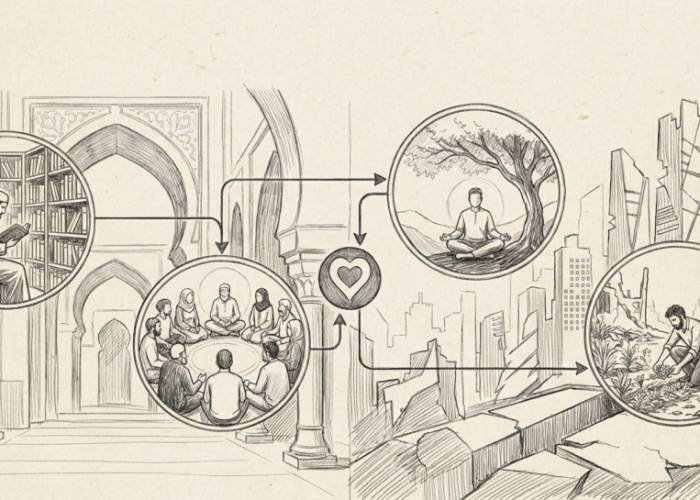
A Dynamic Dance of Identities
These are not static boxes, but stations in a lifelong journey of search. Individuals often cycle through them: a rebellious secular youth may turn to fundamentalism after a crisis, only to mellow into a conciliatory pragmatism with age and responsibility. The patterns constantly interact, clash, and form uneasy alliances on the societal stage, creating a "cold ethical war" that fragments public discourse into isolated islands of meaning.
Toward a Creative Synthesis
The data from across the region suggests no single path will triumph. The future lies not in the victory of one, but in the creative interaction of all. The fundamentalist reminds us of our non-negotiable need for meaning; the conciliatory teaches the vital skill of adaptation; the secularist upholds the critical role of reason; and the non-affiliated reflects the raw reality of our disruptive age.
The great task, therefore, is to foster an ethics of coexistence. This requires building institutions flexible enough to hold pluralism, creating genuine spaces for moral dialogue across divides, and educating new generations in the art of living with difference. The goal is the emergence of a new, integrative ethic—one that is simultaneously rooted in tradition and open to the future. The journey is arduous, but within this very struggle lies the potential for a richer, more resilient moral foundation for Arab societies in the 21st century.
Brief Reference List
1. Core Theoretical Framework
Berger, P. L., & Luckmann, T. (1966). The Social Construction of Reality. Anchor.
Giddens, A. (1991). Modernity and Self-Identity. Stanford University Press.
2. Fundamentalism & Religious Identity
Roy, O. (2004). Globalized Islam: The Search for a New Ummah. Columbia University Press.
3. Secularism & Modernity in Arab Thought
Hourani, A. (1962). Arabic Thought in the Liberal Age. Cambridge University Press.
4. Hybridity & Cultural Adaptation
Bhabha, H. K. (1994). The Location of Culture. Routledge.
5. Liquid Modernity & Non-Affiliation
Bauman, Z. (2000). Liquid Modernity. Polity Press.
6. Empirical Data & Regional Reports
UNDP. (2022). Arab Human Development Report.
Arab Center for Research & Policy Studies. (2023). Survey of Values in Eight Arab Countries.
______________________
This research paper was prepared by Mohamed Hamdan, an academic focuses on cultural studies.


Comments About This Article
Please fill the fields below.