

The General Electricity Transmission and Distribution Corporation has approved a "presumptive estimation" mechanism for the consumption of subscribers who lack single-phase meters.
Although the decision was presented under the guise of "regulating operations," it implicitly acknowledges the inability to secure the necessary equipment, with the financial burden of this shortfall being passed on to the end consumer.
Acknowledging the Logistical Shortcomings
The corporation began its decision with the phrase "due to the unavailability of meters," which constitutes an admission of the system's failure to meet the demand for measuring devices.
Instead of finding logistical solutions to secure these meters, the ministry resorted to imposing "hypothetical consumption quantities"—at the already high new tariff—thus undermining the principle of fair billing based on "paying for actual consumption."
The decision includes imposing a fixed consumption limit of 400 kilowatt-hours (kWh) per billing cycle, a figure that observers consider high given the hours of power rationing experienced by most governorates.
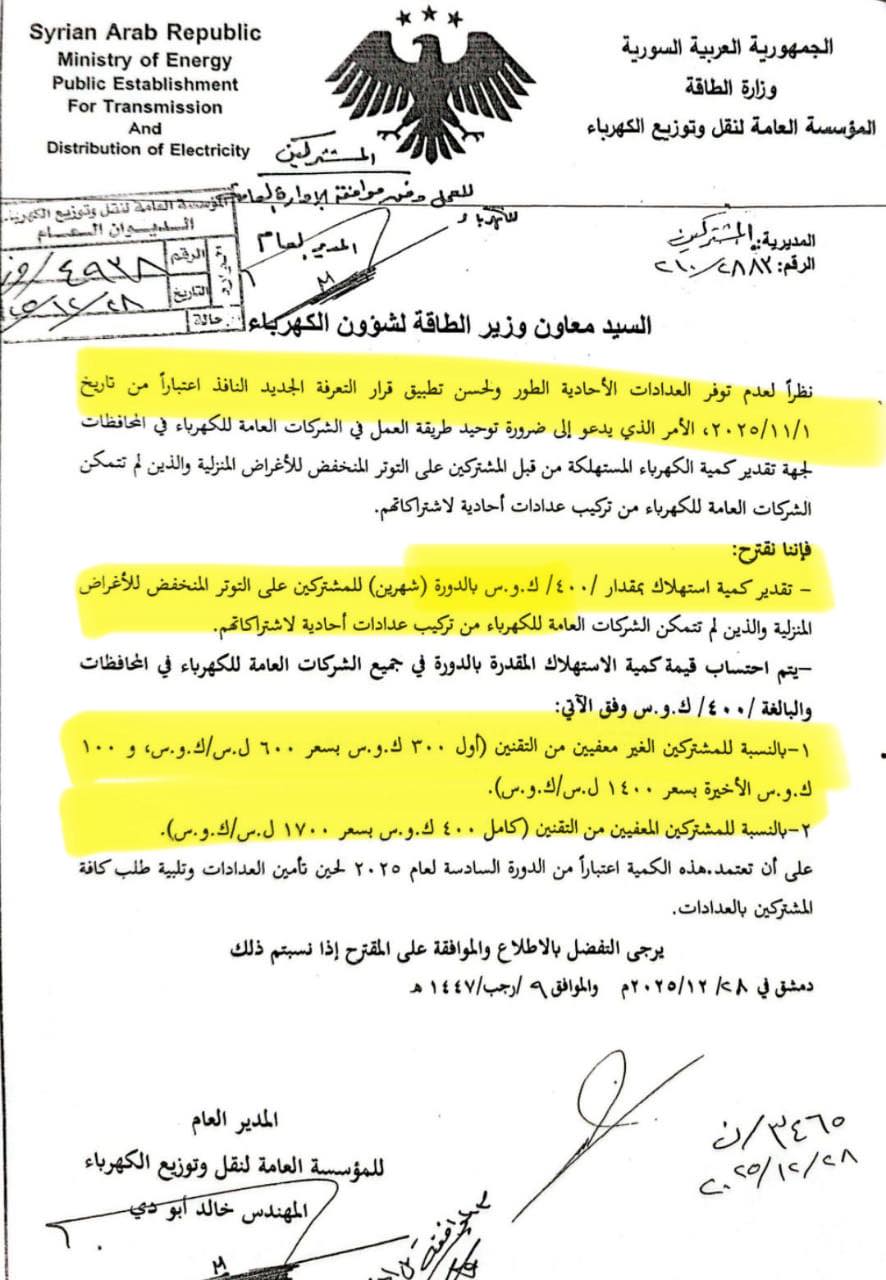
The problem lies in:
- Price tiers: Distributing estimated consumption across price tiers starting at 600 Syrian pounds per kilowatt-hour (kWh) and reaching 1400 pounds for the last 100 kWh results in high bills for subscribers without any physical proof (meter) of their actual consumption.
- Exempt lines: Imposing a fixed price of 1700 pounds per kWh for the entire estimated consumption reflects a clear desire to collect revenue regardless of the actual fluctuations in the subscriber's consumption.
The ambiguity of the "temporary" measure and its impact on living standards: Although the decision states that this measure is "temporary" until meters are secured, the lack of a clear timeframe for securing these meters raises concerns about the sustainability of this approach. Imposing fees based on "office projections" is inconsistent with the standards of quality public services, especially given the current economic conditions that demand extreme accuracy in calculating costs for citizens.
There are uninhabited and partially destroyed houses; how will electricity tariffs be calculated for them?!
Al-Hussein Al-Shishakli - Zaman Al-Wasl
EQTSAD


Comments About This Article
Please fill the fields below.