

Internal documents issued by the Ministry of Foreign Affairs and Expatriates revealed decisions to transfer and appoint 31 diplomatic staff members to senior positions in foreign missions, raising questions about the legal justifications used, the criteria for career progression, and the academic qualifications of those involved.
Decision No. 61 of 2026, addressed to the Directorate of Financial Affairs, cited "Law 53" as the legislative basis for settling the financial status of the transferred individuals.
This reliance raises legal concerns, as Law 53 in Syrian legislation pertains to consumer protection (2021) or military penalties (1950), neither of which relates to diplomatic work.
This discrepancy suggests a serious administrative error or reliance on unofficial legal references, such as the basic employee law issued by the "Salvation Government" affiliated with Hayat Tahrir al-Sham in Idlib, which bears the same number (53 of 2021).
The list included the appointment of 12 individuals to the rank of "Minister Plenipotentiary," a rank immediately preceding that of ambassador and typically requiring several years of continuous diplomatic service.
The names included in the appointments to sensitive international posts are:
Transferred to the rank of Minister Plenipotentiary:
- Anas Al-Badawi (to Bucharest - Al-Badawi signed the financial decision for himself).
- Nazir Al-Qadri (to Jeddah).
- Mohsen Mahbash (to Riyadh).
- Khaled Eid Sheikh Mahmoud (to Istanbul).
- Fadi Al-Qassem (to Ankara).
- Ali Jamal Al-Din Mustafa (to Gaziantep).
- Muhammad Taha Al-Ahmad (to Cairo).
- Muhammad Qantari (to Washington).
- Iyad Al-Hazza (to Beirut).
- Zakaria Lababidi (to Beijing).
- Samir Al-Shalabi (to Tripoli).
- Abdul Wahab Muhammad Agha (to Tokyo).
- Muhammad Baraa Shukri (to Berlin) - son of the current Minister of Religious Endowments -
- Mulham Al-Khan (to Bonn)
- Muhammad Katoub (as Chargé d'Affaires to The Hague)
Transferred with the rank of First Secretary and Counselor:
- Rami Abaza (First Secretary - Jeddah)
- Muhannad Othman (First Secretary - Riyadh)
- Ahmed Dbeis (First Secretary - Ankara)
- Abdullah Al-Hamash (First Secretary - Gaziantep)
- Jumaa Al-Anzi (First Secretary - Cairo)
- Ahmed Al-Malati (First Secretary - Washington)
- Nada Aswad (First Secretary - Beirut)
- Ahmed Qara Ali (First Secretary - Beijing)
- Muhammad Tannari (First Secretary - Tripoli)
- Yasser Al-Hussein (First Secretary - Muscat)
- Amer Al-Muhammad Al-Abdullah (First Secretary - Muscat)
- Ayham Najm Al-Aboud (First Secretary - Brussels) - Bahia Mardini (Advisor - Brussels).
- Muhammad al-Sharif (First Secretary - Tokyo).
- Munther Ali al-Zoubi (First Secretary - Rome).
- Muhammad al-Najjar (First Secretary - Berlin).
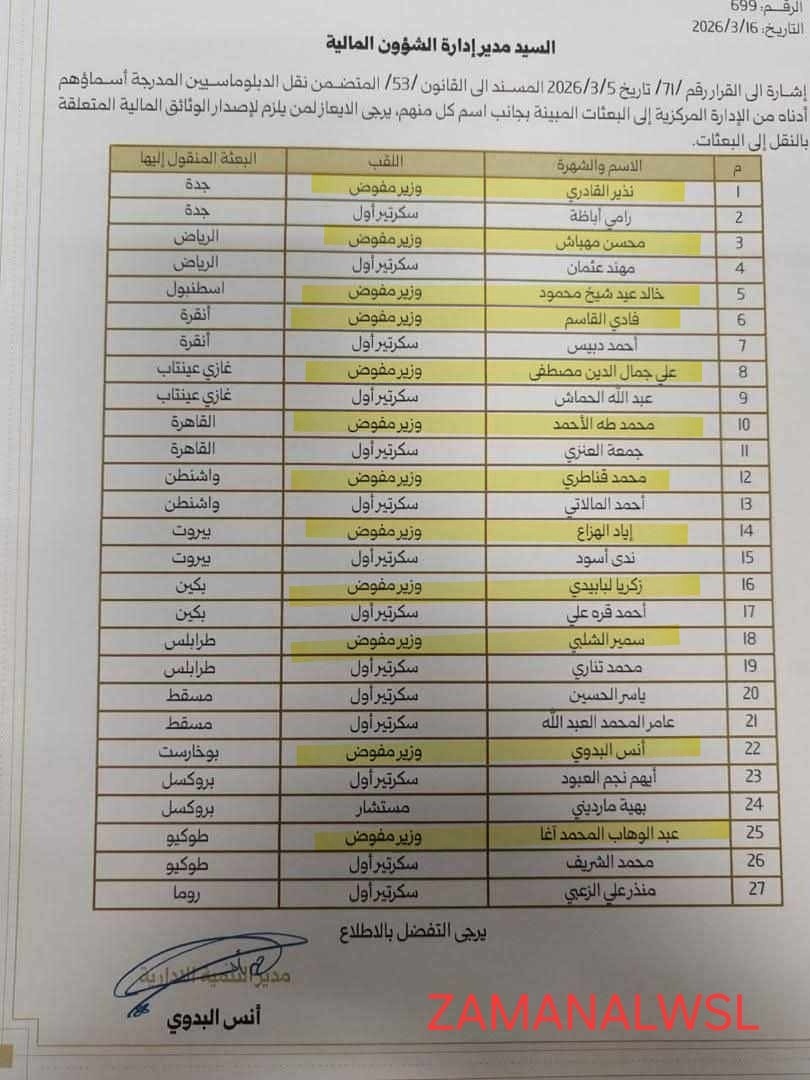
The documents revealed a conflict of interest, as Anas al-Badawi, in his capacity as Director of the Administrative Development Department at the Ministry, signed a decision concerning his "financial affairs" at the Bucharest mission, to which he was transferred with the rank of Minister Plenipotentiary.
These extensive appointments to posts such as Washington, Beijing, and Brussels, without clarity regarding the academic or professional background of some of the appointees, raise questions about the merit-based criteria used in the diplomatic corps, especially given the existence of defecting diplomats with the necessary experience to fill these positions according to the traditional hierarchical system.
- An ambassador requires the approval of the host country, while a Minister Plenipotentiary or Chargé d'Affaires does not.
No official comment has yet been issued by the Syrian Foreign Minister to clarify the legal basis for the decision or to address the administrative shortcomings identified in the documents.
Zaman Al Wasl


Comments About This Article
Please fill the fields below.