

From the very first moment of reading the play’s title, Tunisian writer and director Mohamed Kouas places us before a linguistic and semantic shock. “Al-Insawan” is not merely a verbal blend of “insan” (human) and “hayawan” (animal); it is an identity card for a contemporary being in crisis, oscillating between the fragile veneer of civilization and the call of savage instinct. In this production, produced by Be Actor Studio, Kouas turns the stage into an open human laboratory that strips bare our moral claims and places our daily behavior under the microscope of black comedy.
From “Bayt al-Quʿad” to a Laboratory of Power
The conflict in “Al-Insawan” does not begin on the chair, but around the patriarchal domination that mobilizes the entire family to serve one pleasure: the father’s continued watching of his favorite program, “The World of Al-Insawan.” The family is distributed across the roof and the entrance, as if forming a human chain to catch the broadcast, in a scene that condenses an entire authoritarian structure: a father who owns the right to watch, and a family that pays the price in movement and waiting. Here, “familiality” becomes the main theme of the performance, not merely a dramatic backdrop; the chair—the chair of power and patriarchy—is only part of this structure and a symbol of it.
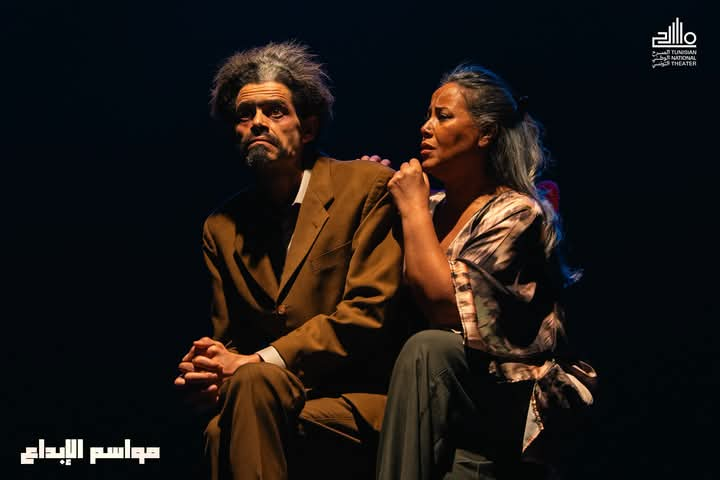
This symbol is visually reinforced by a deep red chair resembling a royal throne, on which the domineering father is accustomed to sitting while watching his program. The irony, however, lies in the fact that the children, when they try to sit on the chair, retreat from the act at the last moment; as if they refuse to reproduce the same authoritarian experience. Thus the performance offers neither a mythological solution nor a ready-made exit from this family impasse.
Through this narrow circle, the work touches on the idea of the “power of details” that permeates the most intimate family relationships. The television, which gathers them and separates them at once, appears as a machine for numbing consciousness, turning individuals into consuming creatures who fight over the viewing angle and forget to ask the real questions. Indeed, the performance goes further: at one moment, it suggests that what we see is not inside the screen where the family crowds, but in front of it; that is, the family itself is the material on display, not the viewer.
A Greek Family with Hidden Coding
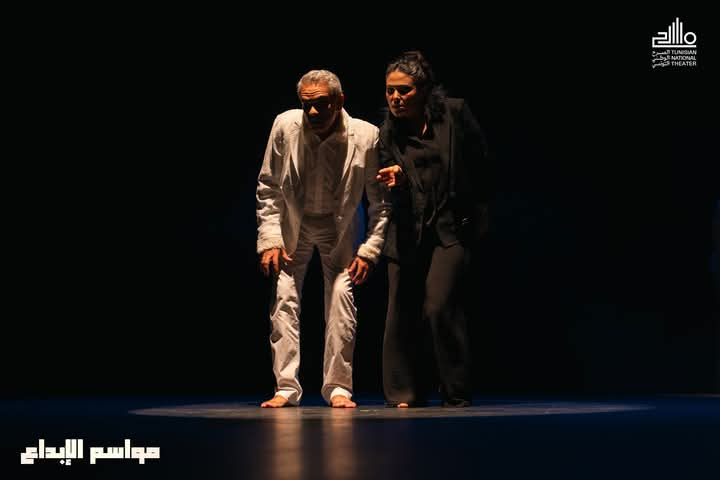
Through this family, Kouas evokes its Greek counterpart with hidden coding: six siblings—three in black clothing and three in white—as if they were peers from two opposing worlds. Here, an ordinary daily request, such as going up to the roof or coming down to fix the satellite dish, turns into a paradox between a pure world and a dark world. In this sense, the satellite dish itself becomes a symbol of hesitation and waiting: waiting for the broadcast signal, waiting for reconciliation, and waiting for deliverance.
This mythical dimension is supported by frequency numbers that evoke pivotal stations of wars that changed the twentieth century: 1915, 1939, 1945, 1967, 1987, with mention of casualty figures in the same context. Thus the living room becomes a suspended space closer to the theatre of the absurd: a place of forced sitting and waiting, where all hopes hang on a satellite dish, just as they hang on a family reconciliation that does not come.
If Nietzsche, in *The Birth of Tragedy*, wondered how the Greek people could enjoy the strife of the family of the gods despite living victories and a life far from tragedy, Kouas reproduces this paradox in a contemporary context: a family watching a program about “The World of Al-Insawan,” in a clear borrowing from animal-world programs, where the commentator’s voice rings out in a voiceover that exposes the absurdity of the human being, his buffoonery, greed, and avarice, and addresses issues of reproduction and economy. Music does not stop at the limits of meaning; it evokes the sounds of the jungle, going so far as to summon the sounds of elephants.
The Aesthetics of Irony and Bodily Transformations
On the visual level, Mohamed Kouas moves away from traditional beautification, betting on biting irony and paradox to reveal the glaring contradiction between what the characters say and what they do when instinct takes control. Body language plays the absolute leading role; we follow a gradual and astonishing transformation in the actors’ performance from calm human behavior to bodily and vocal suggestions that evoke the animal world with all its ferocity and wariness.
This harmonious collective performance finds strong support in Chawki El-Machachi’s lighting, which draws the boundaries of tension and suffocation, and Waddah El-Aouni’s music, which escalates the dramatic rhythm with softness and cunning. Presenting the performance in an intimate space such as L’Artisto doubles the impact of the experience, as the spectator feels trapped inside the same living room, a witness and participant in this game.
This construction is completed by the Eid scene, which is supposed to be an occasion for reconciliation and family gathering; instead, the Eid greetings come without heart, mere words, while hatred, rancor, and suffocation remain present. Thus the horizon of reconciliation is tested at the very moment it is supposed to be realized: not only does something difficult to repair occur, but the struggle around the father’s chair remains inflamed.
A Distinctive Imprint on the Tunisian Theatre Scene
The play “Al-Insawan” acquires clear particularity when compared with many current Tunisian theatre works. At a time when an important part of production tends toward monodrama, direct documentation, or the recovery of the past, Kouas chooses to bet on collective play and philosophical symbolism. The performance also avoids the trap of direct political discourse and ready-made slogans, moving instead toward the essence of the crisis: human nature itself when it loses its moral compass.
The work participated in the Seasons of Creativity of the Tunisian National Theatre between October 23 and November 7, and was presented at the Jordan Theatre Festival, where it won two awards. Its last performance was at L’Artisto on November 17, with a performance scheduled within the Carthage Theatre Days on November 24 at the Hall of Young Creators.
Despite its calm aesthetics and dynamism, the work may seem booby-trapped and weighed down by certain references; this makes it a rich human meal that requires patient reading. The main criticism, however, lies at the level of dramaturgy: despite the quality of the distribution of climaxes, they gather in the last twenty minutes of the performance. Reconsidering some of them might have given the performance rhythm better balance and distributed tension across the performance instead of stacking it in its finale.
“Al-Insawan” offers no magical solutions or comfortable ending; it leaves the audience before a frank mirror reflecting our fragility when tested by interests. Through this balance between depth of idea, power of collective performance, and scenographic intelligence, Mohamed Kouas confirms his presence as one of the theatrical voices capable of turning the smallest details of our daily lives into existential questions that touch every human being.
By Mohamed Hussein Hamdan
Syrian writer and theatre director


Comments About This Article
Please fill the fields below.