

While the Ministry of Foreign Affairs and Expatriates, through its online platforms, emphasizes a competitive recruitment system based on rigorous criteria and public competitions, appointments to some vital diplomatic missions raise questions about the alignment between theoretical legal standards and practical administrative realities.
Observers believe that the selection mechanisms for some influential capitals are sometimes subject to considerations and balances that differ from the standard criteria used in public competitions.
Publicized Competitions and Specialized Requirements on Paper
Official data from the Ministry of Foreign Affairs' electronic recruitment system (competition.mofaex.gov.sy) demonstrates the precision of the concepts and criteria required for entry into the diplomatic corps. The tests encompass multiple aspects, distributed as follows:
• Specialized Academic Background: Applicants undergo comprehensive written examinations covering international law (public and private), civil law, domestic legislation, and political science with its various systems and theories.
• Linguistic and Skills Proficiency: The competitions include automated tests in foreign languages (such as English), in addition to tests in oral translation and diplomatic discourse.
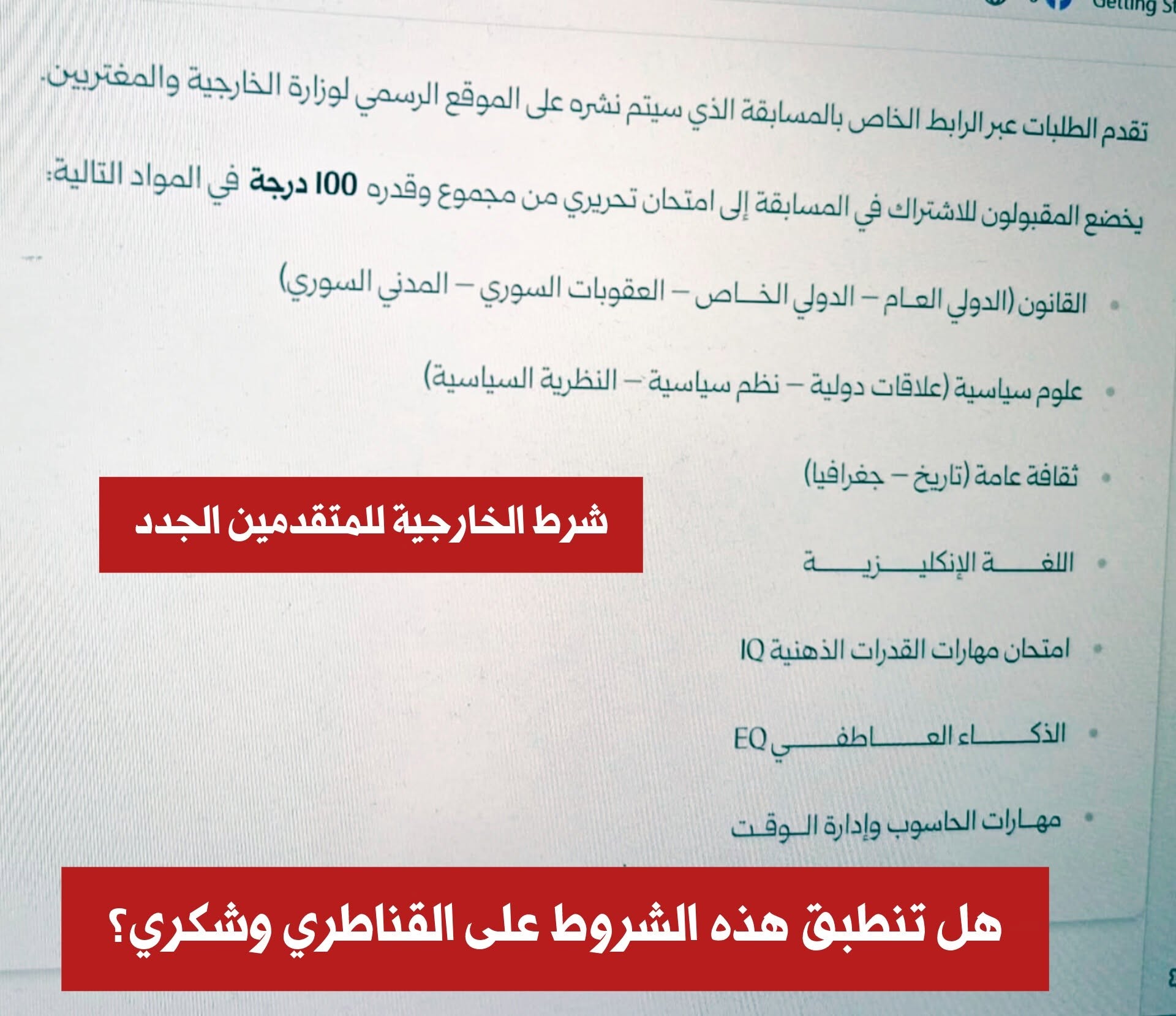
• Behavioral and Psychological Standards: Incorporating tests of intellectual ability (IQ) and emotional intelligence (EQ), along with assessments of suitability for managing diplomatic crises.
• Mandatory Qualification: Successful candidates are required to enroll in an intensive three-month training course at the Diplomatic Institute. The right to a contract is only confirmed upon successful completion of the course.
Appointments in Washington and Berlin: An Examination of Administrative Backgrounds
When comparing these general academic requirements with recent leadership appointments at the embassies in Washington and Berlin, a discrepancy emerges in the application of the usual standards. Some attribute this to specific political or administrative considerations:
1. The Washington Mission: Academic Specialization vs. Political Practice
The appointment of civil engineer Mohammed Qantari as chargé d'affaires in Washington, D.C., was an exceptional case in diplomatic practice. A graduate of the International University of Cyprus with a specialization in civil engineering, he was entrusted with managing a mission in one of the world's most complex political capitals. This selection suggests that considerations of trust and direct assignment took precedence over the requirement of "specialized academic background in international law or political science."
2. Berlin Mission: Evaluating Administrative Performance and Diplomatic Tasks
The appointment of Mohammad Baraa Shukri as Chargé d'Affaires in Germany at the beginning of 2026 sparked mixed reactions, particularly after an evaluation of his previous tenure at the Istanbul Consulate, which was marked by administrative pressures and a backlog of consular services for expatriates. Critics of this approach argue that an appointment to a capital city with a large Syrian community like Berlin necessitated a focus on administrative flexibility and regional and linguistic competence. Others, however, believe the appointment aligns with the Ministry's vision of distributing tasks according to specific tactical requirements.
Organizational Structure and Career Advancement Opportunities
The discussion extends beyond individual qualifications to encompass the very structure of diplomatic work. While regulations require new graduates to undergo sequential probationary periods and specialized training at the Diplomatic Institute before being confirmed, the reliance on direct appointments to senior positions (such as Chargé d'Affaires) sometimes bypasses this traditional progression.
Those concerned with administrative affairs point out that this discrepancy between the public competition process and the direct appointment process may affect the aspirations of specialized personnel within the ministry, and highlights the need to unify standards to ensure the highest levels of efficiency and public interest in representing the state abroad.
Zaman al-Wasl


Comments About This Article
Please fill the fields below.