

Tunis - Mofida Khalil "We are the plaything of our memories, no matter how much we resist, both their essences and their victims." — A statement by Jabra Ibrahim Jabra that summarizes the curse of memory. Memory is the being of humans and societies, the echo of heritage and the voice and stories of those who came before. Memory is the thermometer of life; stories are built from it, and lovers rely on it. This memory, laden with place and time, transforms into a pain that afflicts all refugees. Memories become like fire, and only art is capable of extinguishing it. From the anguish of memories, the fragmentation of homeland, and the remnants of hope, the play "Residence Permit" emerged—another cry affirming that man's journey in search of his homeland does not end with asylum, and that war is powerless against the solidity of memory. "Residence Permit," written and directed by the Syrian Mohamed Hussein Hamdan and performed by the Lebanese actress Umayma Mouwaly, is a cry of life, hope, and the extent of human resilience at the gateway of the "Residence Permit." The Residence Permit: A Paper That Erases a Person's Existence in the Host Country They carry their homelands wherever they go. They gather the fragments of the homeland and its memories within the chambers of their hearts, hiding them away to flee to them whenever they feel estrangement or weakness. The homeland is not just a home or geography; it is the laughter of children in the streets, the scent of morning flowers, the voices of grandmothers and the songs of young girls, an old TV series, dialogues about freedom, theater, and art. The homeland is that magical spark that illuminates the paths whenever the weight of estrangement intensifies. Perhaps it is sometimes the soul itself. "The homeland is the house, the mulberry tree, the chicken coop, the beehive, the smell of bread, and the first sky," as Mahmoud Darwish says. This homeland is carried by director Mohammad Hussein Hamdan, who transforms it into a theatrical text, believing in the immense power of theater to preserve all memories.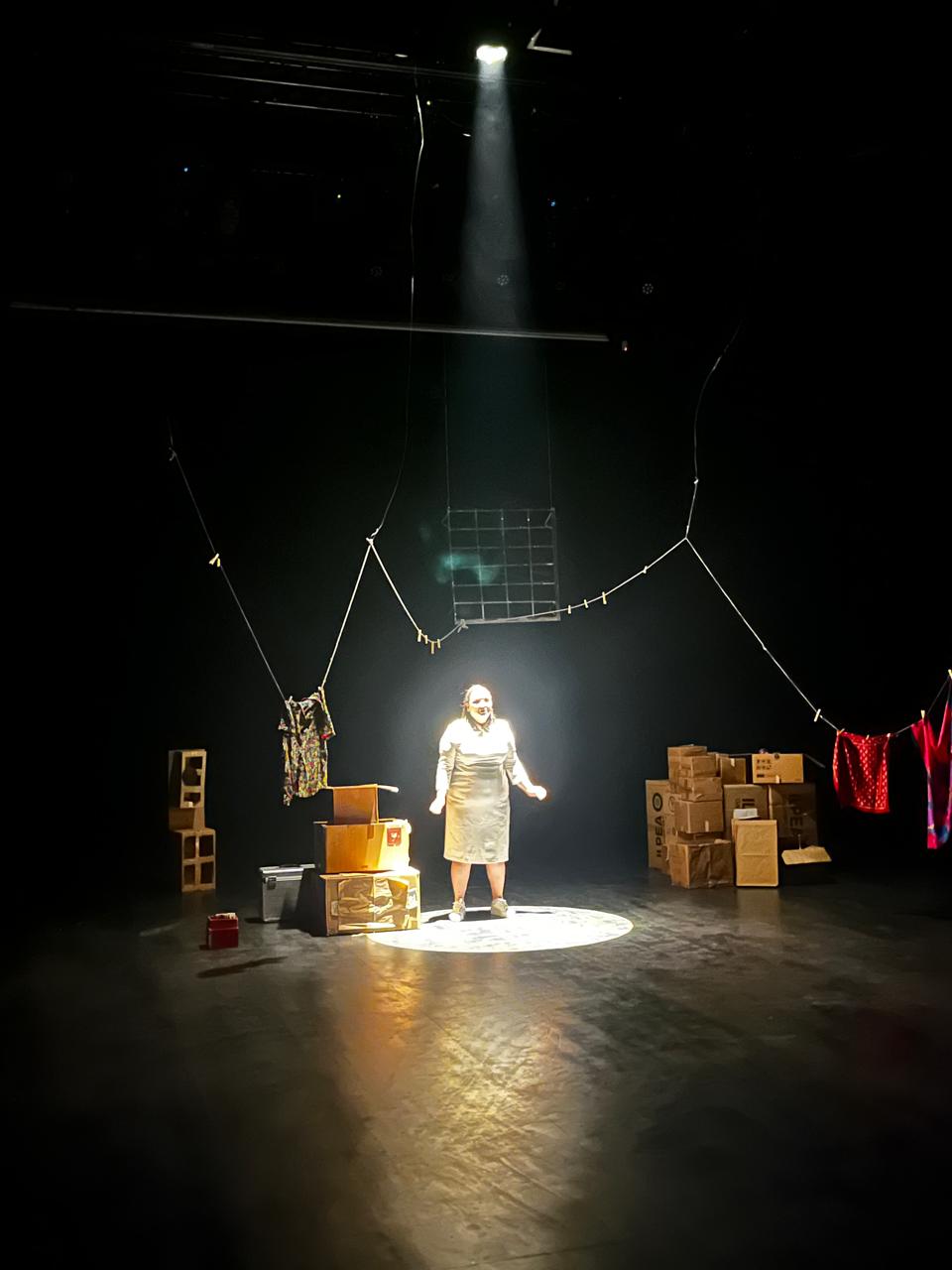
After the Syrian revolution, Tunisia became a refuge for many Syrians—refugees who fled the hell of war in Syria to Turkey and then to Tunisia. In the land of Carthage, they coexisted with its inhabitants; Tunisia loved them and Tunisians loved them back, and many decided to stay in this loving country. From the womb of reality and the stories, pains, and sufferings of many Syrians since they left their homeland, the text of the play "Residence Permit" was born, written and directed by the Syrian journalist and theatre maker Mohammad Hussein Hamdan.
"Residence Permit" is a tragic play resembling a process of psychological catharsis. Its events unfold between the tangible, real world (Syria/Tunisia) and another mythical world—the underworld. The heroine of the story often emerges from her humanity to become like Persephone—half-human, half-goddess—living six months on the surface of the earth and the rest in the underworlds. This mythical character shares the idea of pain with all tormented refugee women, torn between an existing homeland and a lost one. At times, she is also the mythical Ereshkigal of Mesopotamia. The underworld in the play sometimes represents the refuge itself; the hell of war and psychological devastation merge with the darkness of the mythical underworld.
"Residence Permit" is a simple title that conceals much pain. From the title itself, the director establishes the dramatic framework of the play: the character's story will revolve around the residence permit—that paper she must obtain to prove her existence in Tunisia. A stamped document that protects her from deportation and confirms the legality of her presence here. But before obtaining this permit, there are many stages: losing one's name and being replaced by a number, waiting for hours and perhaps days in an endless queue, a journey of psychological loss, and recurring questions: What is a homeland? How do we protect our memories from being lost? What does a refugee do in a country not their own? How can they gradually adapt? Do they carry their heritage and culture, or are they forced to leave them there, on the edge of homeland and memory?
For 45 minutes, actress Umayma Mouwaly plays on the meanings of confusion and fear. She is bold to the point of terror in scenes discussing love, motherhood, and memories of a cohesive family—like a clothesline with its bright colors. At other times, she collapses into a realm of nihilism whenever she invokes the voice of death and the smell of war. Between these contradictory emotions—much like death and life themselves—the actress dances with her fragmented text against the waves of displacement and the constant search for the residence permit.
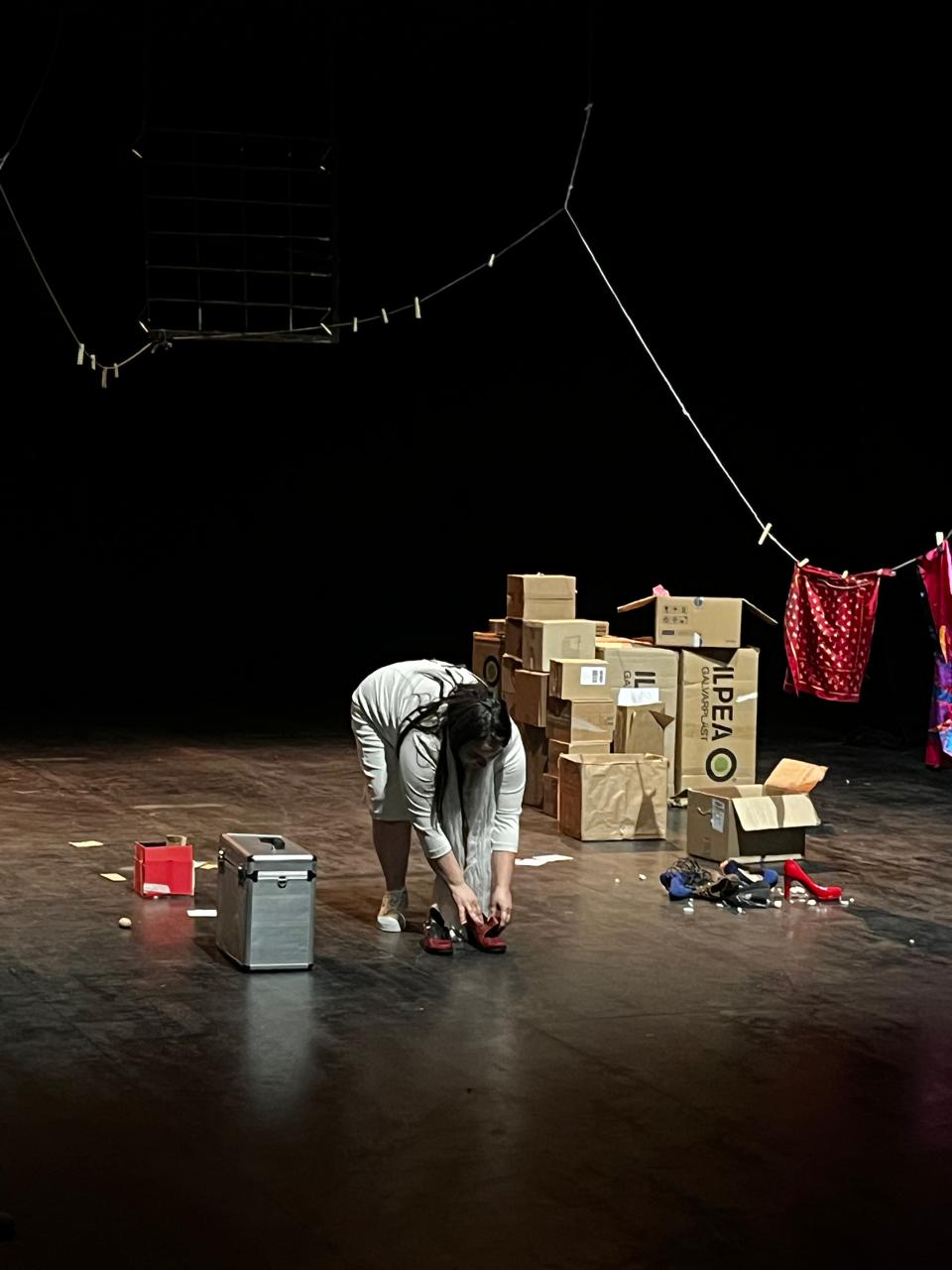
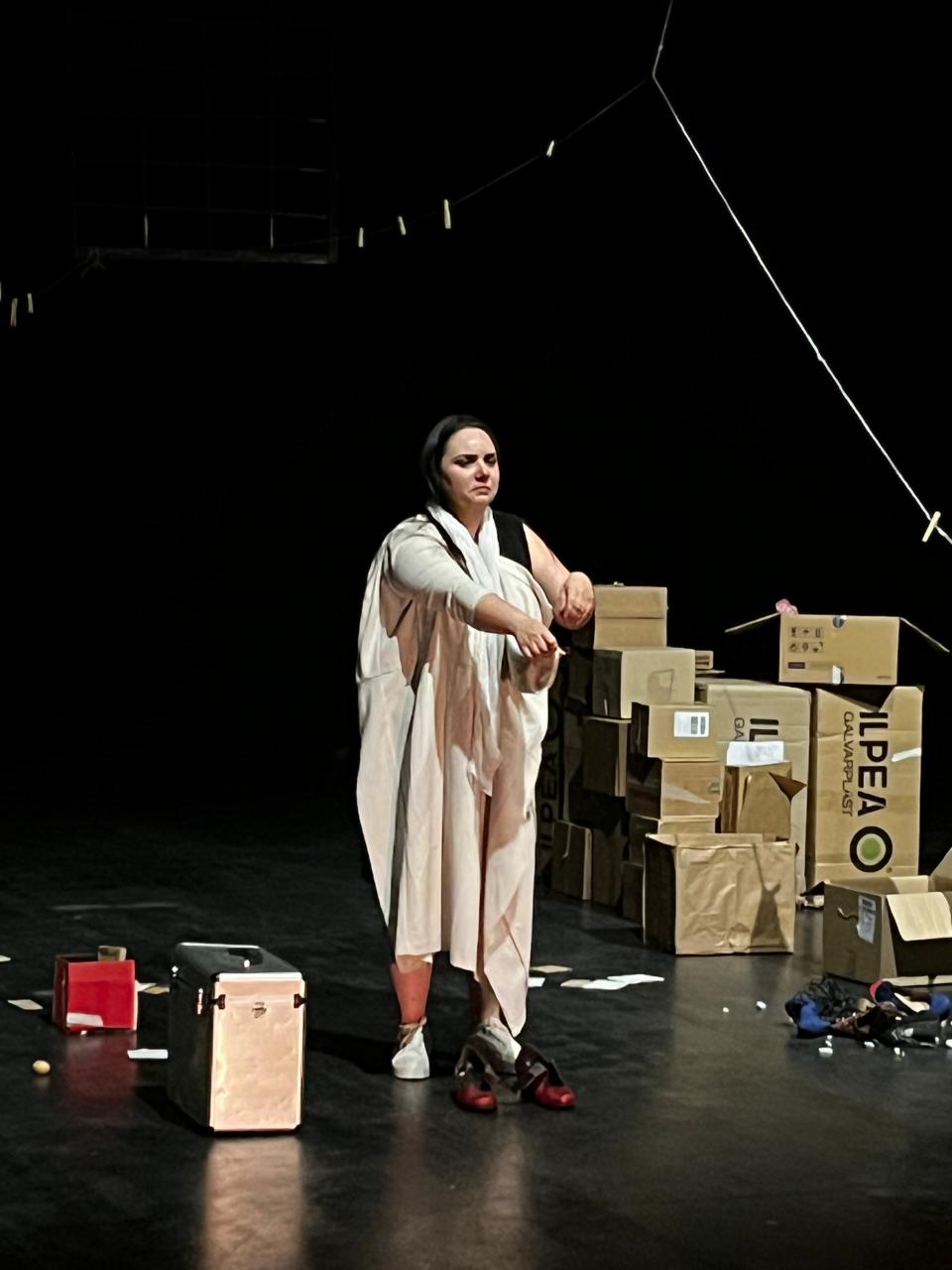
The character oscillates between myth and reality, searching for herself, trying to plant her feet in the new land, but the curse of memories accompanies her. The character is renewed with every pain. In the final scene, she removes her red high-heeled shoes and replaces them with sports shoes, as if reclaiming the continuous journey of escape that all war refugees experience in countries other than their own.
The character's memory returns to the myth of the founding of this land (Tunisia). She carries her memories to the ruins of Carthage, donning the spirit of Dido (Elissa), who fled the hell of her homeland to another that would become her sanctuary. The character will do the same—she will build her homeland wherever she goes, because homeland is part of the soul, not geography. The character says: "The difference between us is that she was a princess and had gold, but perhaps this is enough; the temporary residence permit will remain temporary, but my residence in my self is permanent. The homeland is not land; the homeland is knowing who you are. I am my own city. I will live in it alone, and I will open its doors to everyone searching for a homeland like me. This wooden key that Joseph made for me one day does not open a door, but it reminds me that I once had a home, and this is enough. I don't need to go back; I only need to know that what was once real will remain real."
Scenography Laden with Meanings of Loss and Colors of Pain
"Residence Permit" is a monodrama performed on stage by Lebanese actress Umayma Mouwaly, directed by Mohammad Hussein Hamdan, and produced by the Mohamed El-Haidari Theater Association in Beja. A work bringing together Tunisia, Syria, and Lebanon, the stage contained them and listened to their ideas and dreams, transforming them into a theatrical experience that takes the spectator into myth and returns them to reality.
Between two highly contrasting worlds, the actress performs. The text was written with the anguish of losing a homeland, still inhabited by the nostalgia for return, and was presented with the passion of a child witnessing the numerous wars her country endures, still resisting through art. Theater is not just a gateway to writing or acting; it becomes the antidote that saves them from the poison of estrangement and the hiss of alienation.
Between "there" and "there" are miles of distance. Between the original homeland and the country of residence are numerous differences: There lies childhood, the moment of first birth, family and its memories, education and friends. Here lies another, more mature experience, with memories being written anew. Between here and there, the soul is torn daily, trying to build another, clearer life—a country without conflicts or war—but the soul remains suspended in "there," like a piece of clothing on the line danced by the wind. Similarly, the actress moved in her lost, agitated motion on stage. The character searches for her remains, or the remains of her memories, repeating the question: "Mama, you never told me what I should do if the house is lost? If the name is lost? If no one remains to see the handkerchief?"
A single actress embodies multiple characters. Her name is "Awatef" (the plural of emotion, meaning 'Emotions'), a collection of feelings gathered in a single person. She is all displaced women, all dreamers, all mothers who made peace for their children out of the destruction of war. She is Tunisia, Syria, Palestine, Lebanon, and every female entity carried by the theatrical character in its mythical and realistic dimensions. She tells the audience parts of her story, alternating between the Syrian and Tunisian dialects as she lives the schism between them. She carries her audience to Syria, evoking memories.
The set design is simple: a collection of arranged cardboard boxes and a clothesline about to collapse. It might be a storage room where the character lives—a desolate place except for the memories piled inside the "cardboard boxes." These boxes also resemble smuggling containers in trucks; the scattered cork fragments in the hall directly refer to a space for human trafficking. From the set design, the director signals to the audience that the work alludes to the idea of departure, as trucks and their containers were a refuge for many Syrians to reach Europe after arriving in Turkey—they became commodities bid on by human traffickers.
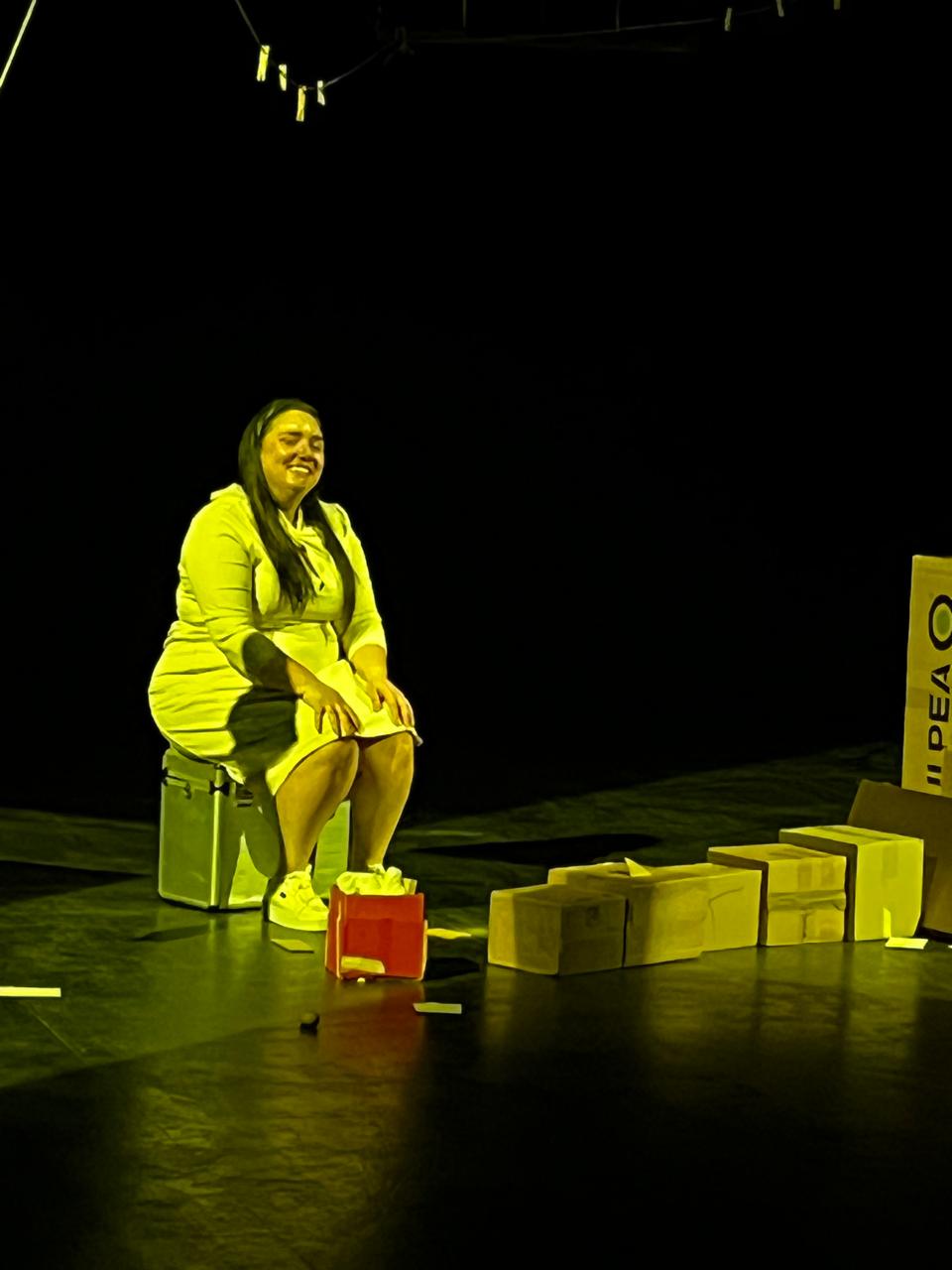
The actress wears black—the blackness of grief within the soul spilling outward. The lighting is very dim, with intense focus on facial features so the spectator can experience all the details of the story and the character's transition between her different worlds. The blackness changes to white in the final part of the work, as if she has moved from a stage of consciousness to madness; for massacres, wars, and the loss of homeland and family, the least severe outcome is madness.
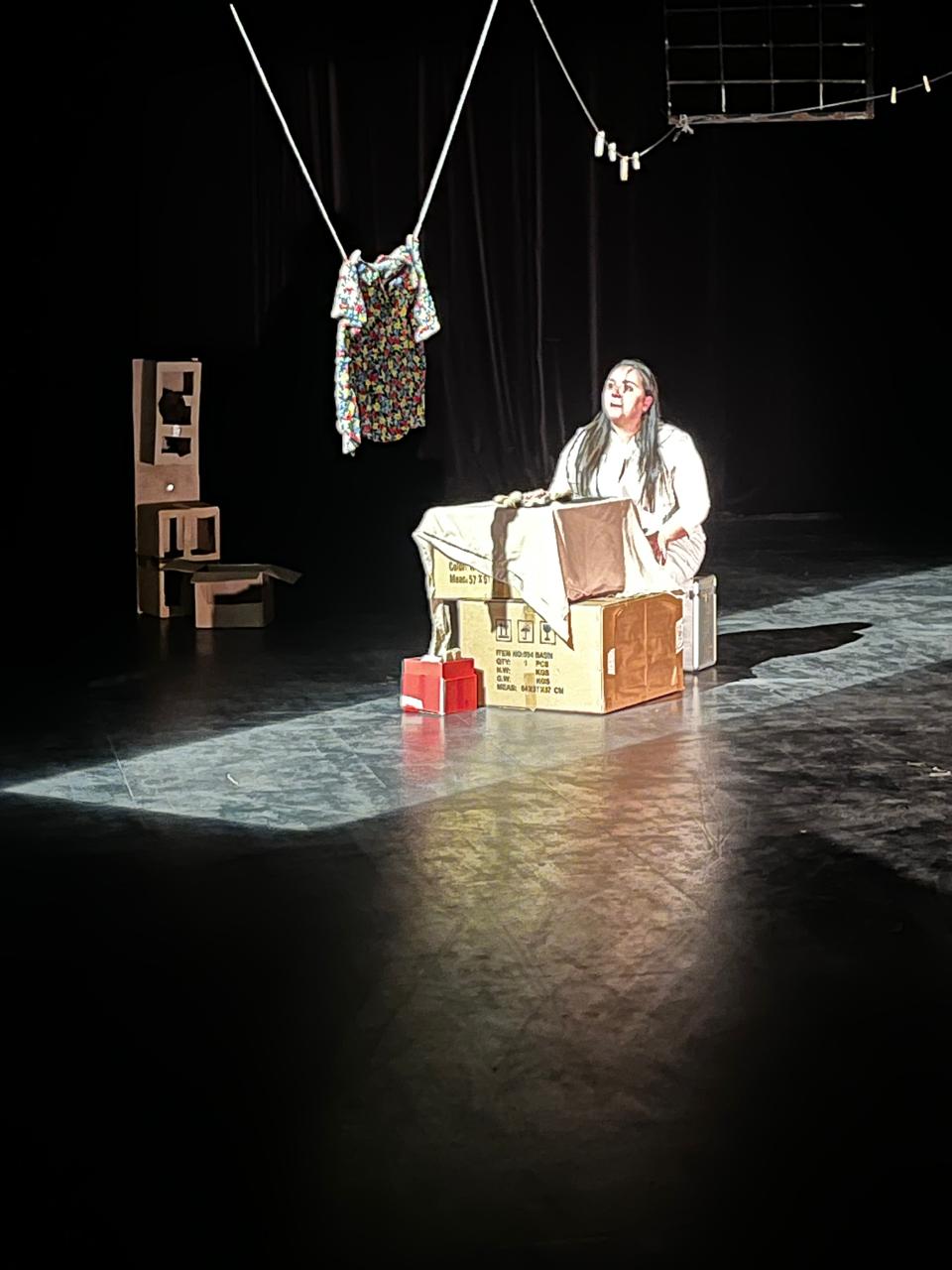
"Awatef" in the waiting queue becomes number "247." From the very first step outside the homeland, the identity of the name is lost. She carries a wooden key that opens no doors, and a "non-conviction" certificate (a document allowing Syrians to reside in the new country). The boxes on stage represent her homeland; she opens them gradually during the process of confession or catharsis. She speaks of love through an empty chair. She mourns her homeland through many pictures of detainees and missing persons since the start of the Syrian war until today. Another box contains the shoes of migrants who fled the death of war to the hell of the sea. There are stories of women, children, and girls raped in dark dungeons—their voices still resembling a curse afflicting those who hear them. The work is not just a play or a confession in the name of war victims; it is a process of spiritual purification the character undergoes, a pain shared by the actress with the audience. In the circle of loss and pain, Mohamed Hussein Hamdan wrote his text and clothed it with the spirit of the mother and the homeland.
Geography is powerfully present in the play through the character's process of recollection. She evokes Homs and childhood. The choice of Homs was not arbitrary but holds great symbolic significance—referring to the fierce resistance the people of Homs showed towards the regime of Bashar al-Assad in an early phase, and later against the blood merchants of ISIS. Homs suffered immensely in the Syrian war, and the city still bears the effects of destruction today. Homs was the first city to rise against Bashar al-Assad's regime, offering much blood; the city was besieged, lived through massacres, and its citizens were deprived of medicine and food for years of siege. The character of the play carries Homs in her memory, hiding it as she would protect her child. During the recollection, images overlap: what the children of Homs experienced—fear and destruction—is what the children of Gaza are experiencing and what the children of Beirut are enduring. All the images of fear caused by war were captured by the playwright and masterfully conveyed by the actress to the theatre audience in Tunisia, affirming that theatre remains a space for experimentation and the search for self.


Comments About This Article
Please fill the fields below.